Serving Minnesota & Iowa for over 25 years
Choosing the best French doors from China starts with more than comparing catalog photos. The right choice depends on where the doors will be installed, how often they will be used, and what the local climate demands. A bright coastal home may need corrosion-resistant hardware, while a cold region calls for careful attention to glazing and weather seals. Details matter.
Quality varies between factories, product lines, and specifications. Look for clear information about frame materials, glass options, locking systems, finishes, and available sizes. Ask suppliers for technical drawings and test documentation relevant to your project and destination. A sample can reveal things a brochure cannot: the smoothness of the handle, the consistency of the finish, and whether the panels align cleanly. Small clues.
A dependable supplier should answer practical questions directly, explain customization limits, and provide realistic production and shipping timelines. Buyers should also confirm packaging methods and inspect the agreed specifications before production begins. These checks do not guarantee a flawless order, and comparing suppliers can take time. I would not choose on price alone; a lower quote may exclude hardware, protective packaging, or installation guidance. The best French doors are those that suit the opening, perform reliably, and arrive with specifications you can verify. This guide explores the features, supplier checks, and trade-offs that help make that decision with greater confidence.
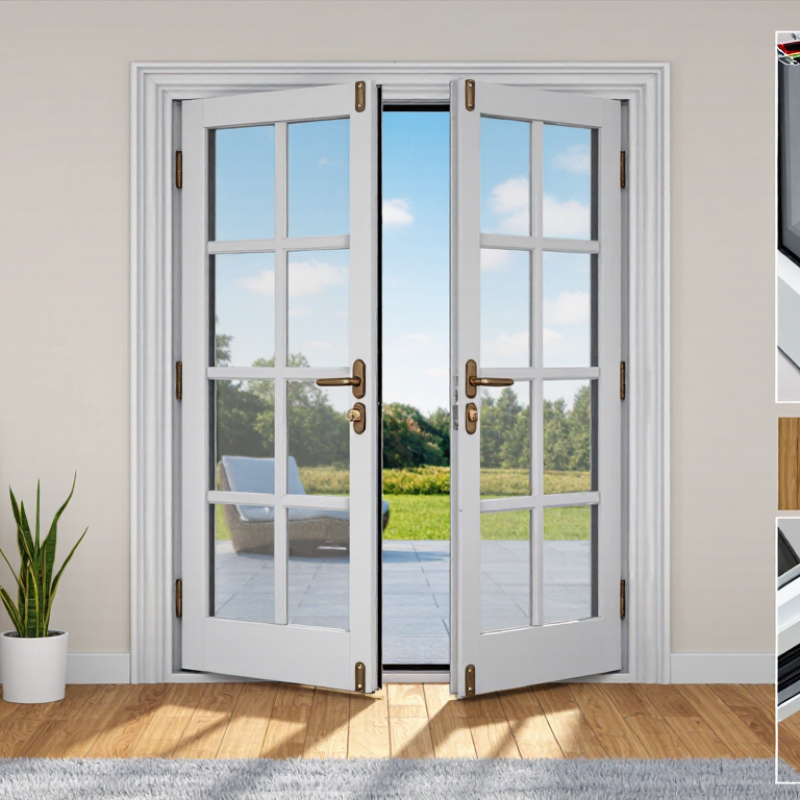
A high-quality French door from China begins with materials that suit the climate. For many projects, thermally broken aluminum offers strength and better insulation. Solid wood can feel warmer, but it needs careful moisture protection. Check the frame corners, surface finish, and drainage paths closely. Small gaps often become large problems.
Glass quality matters just as much. Low-emissivity double glazing can improve comfort near the doorway. Ask for clear specifications, including glass thickness, spacer type, and safety treatment. Reliable doors should also use durable hinges, adjustable rollers, and compression seals. The lock should operate smoothly without forcing the handle. Test it repeatedly.
Factory discipline is equally important. Request production drawings, tolerance details, test reports, and a physical sample. A professional supplier should explain air leakage, water resistance, wind performance, and thermal values in measurable terms. Independent testing adds credibility, but paperwork alone is not enough. Installation can still ruin a well-made door. Confirm opening dimensions, threshold height, flashing, and local fitting responsibility before production.
Some buyers focus too heavily on appearance. That is understandable, but weak hardware may appear months later. I would inspect the bottom track after rain, not only in a showroom. Even experienced buyers can miss alignment issues. A careful pre-shipment inspection, detailed packaging plan, and responsive technical support make the purchase more dependable. Accuracy matters.
Chinese manufacturers offer French doors in aluminum, uPVC, engineered timber, and mixed-material systems. Aluminum provides slim sightlines and strong resistance to humidity. uPVC usually delivers lower cost and reliable thermal insulation. Timber feels warmer, but it needs careful sealing and regular maintenance. Hybrid frames can place aluminum outside and timber inside. They look refined, though their joints deserve close inspection.
Design choices include single or double active leaves, inward or outward opening, folding panels, and fixed sidelights. Low-E double glazing is common, while triple glazing suits colder regions. The U.S. Department of Energy reports that windows can cause 25–30% of residential heating and cooling energy use. The International Energy Agency’s Buildings 2023 report also attributes about 30% of global final energy consumption to buildings. Glass selection matters as much as the frame. Ask for whole-door U-values, solar heat gain data, air leakage results, and water resistance tests.
A practical sourcing lesson is simple: attractive drawings can hide weak hardware. Check stainless-steel hinges, multi-point locks, drainage paths, gasket compression, and corner welds. Look for testing against relevant standards, such as EN 14351-1 or ASTM procedures. Specifications can still be incomplete. Request sample sections, installation details, and factory inspection records before ordering. One overlooked threshold can admit rain, dust, and cold air. peqata
Common frame materials include wood, uPVC, fiberglass, aluminum and steel. Manufacturers also offer different panel layouts, glazing and finishes. The chart compares representative thermal conductivity values for frame materials; lower values indicate less heat conduction through the material itself, not the overall door.
Approximate material values in W/(m·K); actual values vary by material formulation and construction. Whole-door thermal performance depends on the frame, glazing, seals and installation.
When evaluating French door suppliers in China, ask for model-specific test reports, not a general catalog sheet. Check the frame material, glass build-up, weather seals, and hardware details against the exact door you plan to order. The U.S. Department of Energy’s Energy Saver guidance estimates that heat gain and loss through windows account for 25–30% of residential heating and cooling energy use. French doors contain large glazed areas, so request documented thermal performance, such as U-factor and solar heat gain coefficient, and confirm the values match your glass and frame configuration.
Look for air-leakage, water-penetration, and structural test results from a qualified independent laboratory. Standards such as NAFS provide a useful framework for comparing those performance measures; a certificate alone is not enough if it covers a different size or design. Ask how the supplier controls corner joints, drainage paths, and hardware alignment. Small details matter. A sample may slide smoothly in a showroom, yet arrive with a different handle, gasket, or glass specification. Review production drawings, packaging photos, inspection records, and warranty terms before approving a shipment. I would also ask how defects are handled after delivery. That conversation can feel awkward, but it reveals more than polished sales language.
For French doors from China, start with the standards required in the destination market. Ask suppliers for test reports covering air leakage, water penetration, structural performance, and thermal transmission—not just a general “compliant” claim. In North America, buyers may specify NAFS performance ratings and NFRC-rated energy data; acceptance depends on local codes and the project. Small details matter. The U.S. Department of Energy’s Energy Saver guidance estimates that windows account for about 25–30% of residential heating and cooling energy use. Glass choice and frame design can therefore affect comfort and energy bills.
Customization should match the opening and climate. Specify exact frame dimensions, inward or outward swing, active panel, threshold height, and handle position. For cold or noisy locations, compare insulated glazing, low-emissivity coatings, argon fill, and thermally broken frames. Coastal projects may need corrosion-resistant hardware and durable finishes. Request drawings, glass specifications, installation clearances, and samples before production. Ask for proof. A polished sample does not guarantee consistent factory output, so clarify inspection criteria and packaging protection in writing.
Buyers should also confirm whether quoted performance applies to the complete door assembly, including glazing, seals, and hardware. A rating for the glass alone is not enough. I would not assume every option improves performance; thicker glass, for example, can add weight and strain hinges. Get the supplier’s test conditions and warranty terms, then compare them with the intended use and local requirements.
A French-door quote from China should be compared by landed cost, not factory price alone.
Ask for matching details: frame material, glass thickness, hardware, finish, and included accessories. Then request separate figures for production, export packing, freight, insurance, and delivery to your site. Confirm whether unloading is included; a large crate may need special equipment.
UNCTAD’s Review of Maritime Transport 2024 reports that global maritime trade grew 2.4% in 2023, while route disruptions added uncertainty to shipping. Freight estimates can change. Get a validity period and ask what happens if schedules shift.
Installation deserves its own check. Confirm opening measurements, sill preparation, flashing, and who corrects a poor fit.
The U.S. Department of Energy estimates that windows account for 25–30% of residential heating and cooling energy use; glazed doors can also affect comfort, so compare U-factor and solar heat gain data where available. Ask for test documentation, not just verbal performance claims.
Keep it specific. For after-sales support, get written warranty coverage, spare-parts availability, response times, and clear photo-based claim steps.
A low quote may still be costly if local installers cannot obtain replacement hardware. Even a careful spreadsheet can miss that.